

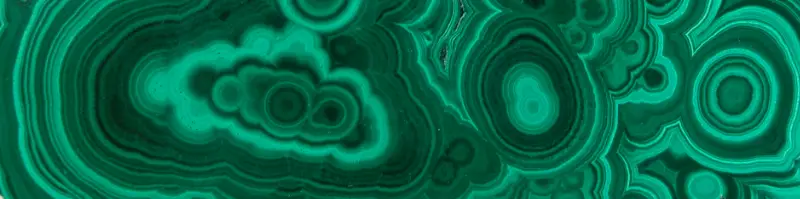


Malachite is a copper carbonate with an unmistakable look: rich green bands swirling in rings and ribbons, like a forest seen from above. It forms where copper ore weathers, often in rounded, bubbly masses, and slicing through them reveals those famous bull's-eye patterns. It has been used for at least 5,000 years, from ancient Egyptian eye paint to entire columns and vases in the Russian tsars' palaces, cut from huge Ural deposits. Today most gem malachite comes from the Democratic Republic of the Congo.
Malachite is soft, 3.5 to 4 on the Mohs scale, and sensitive to acids and heat, so it needs a considerate owner. Choose pendants, earrings and beads over daily rings. It is always cut as cabochons, beads or carvings to show the banding.
Keep it away from perfume, cleaning sprays and hot water, and wipe it with a soft, dry or barely damp cloth.
Genuine malachite feels noticeably heavy for its size and its bands are never perfectly regular, which helps spot plastic and reconstituted imitations.
All copper-born minerals, and malachite often grows tangled together with blue chrysocolla in the same rock.


