

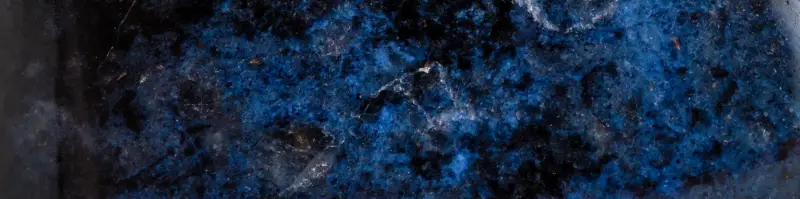


Dumortierite is a blue borosilicate mineral, named after the French palaeontologist Eugene Dumortier. It ranges from denim blue to deep violet-blue, and it most often reaches jewellers as dumortierite in quartz, where fine blue fibres are locked inside a quartz base. It looks so much like lapis lazuli and sodalite that it is regularly mislabelled, but it lacks lapis's golden pyrite flecks. Sources include Madagascar, Mozambique, Brazil, Namibia and the USA. Fun fact: it is also used industrially in making high-grade ceramics.
Dumortierite is impressively hard for a blue stone, around 7 and higher in some material, and it has no troublesome cleavage in its massive form. That makes it a solid choice for rings, beads and everyday pieces. It is usually cut as cabochons and beads, since it is rarely transparent. Cleaning is simple with warm, soapy water. If you are choosing between blue stones for daily wear, dumortierite quietly outperforms softer classics like lapis and sodalite.
Often mistaken for sodalite or lapis lazuli, but noticeably harder than both.


