

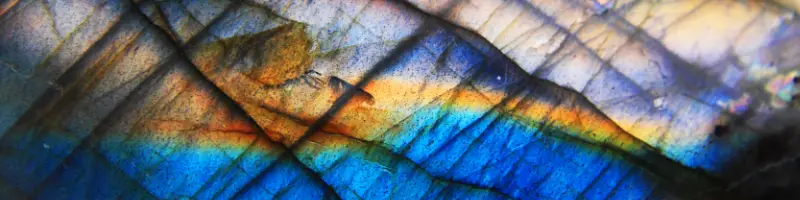


Labradorite is a plagioclase feldspar named after Labrador in Canada, where it was described in 1770. From one angle it looks like plain grey stone. Tilt it, and it erupts in flashes of blue, green, gold and sometimes purple. That effect, labradorescence, happens when light bounces between microscopically thin layers inside the stone. Inuit legend says the northern lights were once trapped in the rocks of Labrador. Fine material also comes from Madagascar and Finland, where the most colourful stone is called spectrolite.
Labradorite sits at 6 to 6.5 on the Mohs scale and, as a feldspar, it has cleavage, so it prefers a slightly careful life. It is nearly always cut as cabochons or flat slices oriented so the flash faces up, and a well-cut stone makes all the difference. Pendants, earrings and bezel-set rings suit it well. Avoid hard knocks and ultrasonic cleaners, and wash it with warm, soapy water. Every stone flashes differently, which is half the fun of choosing one.
All feldspar family. Rainbow moonstone is actually a pale white labradorite with blue flash.


